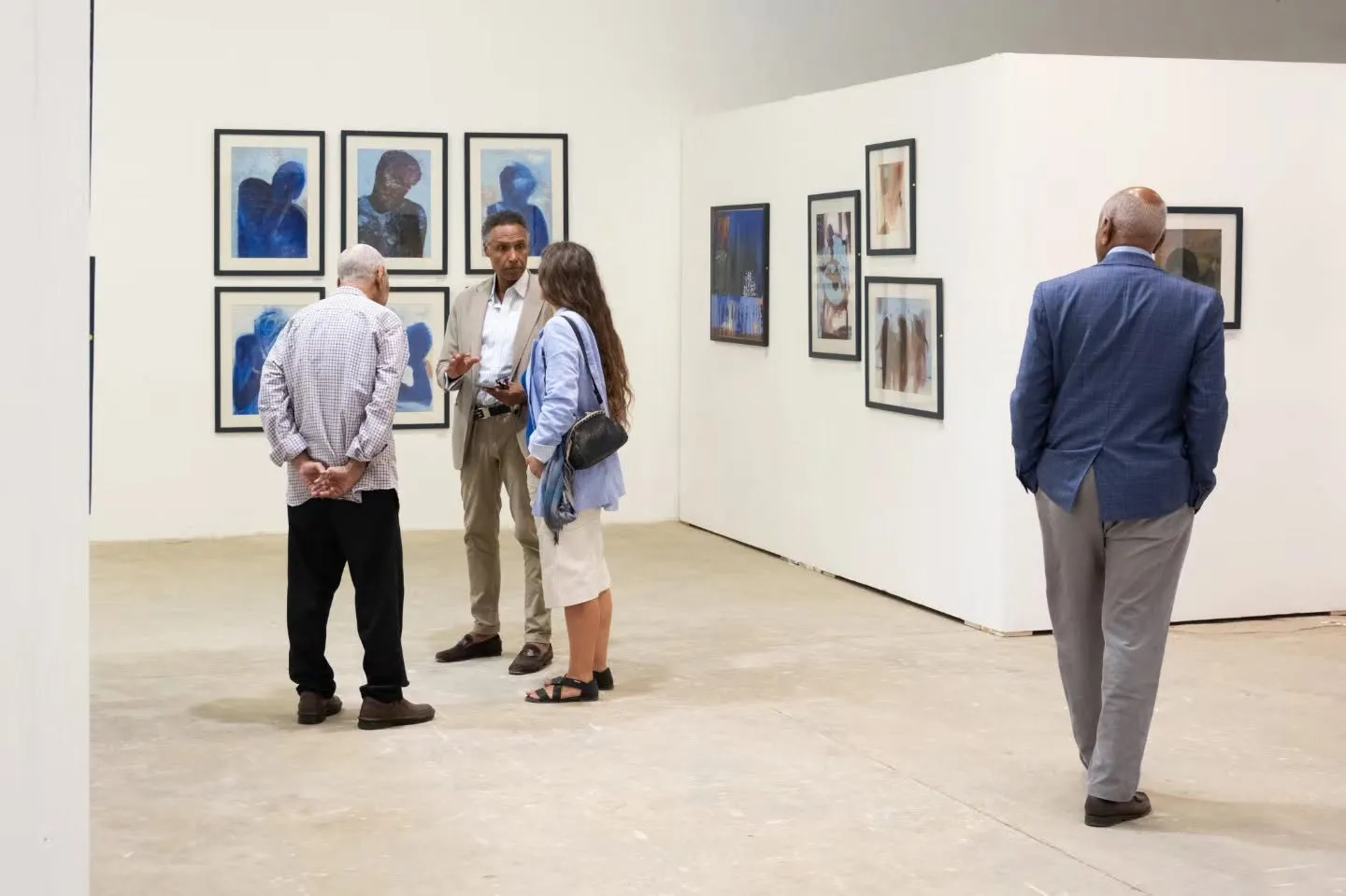
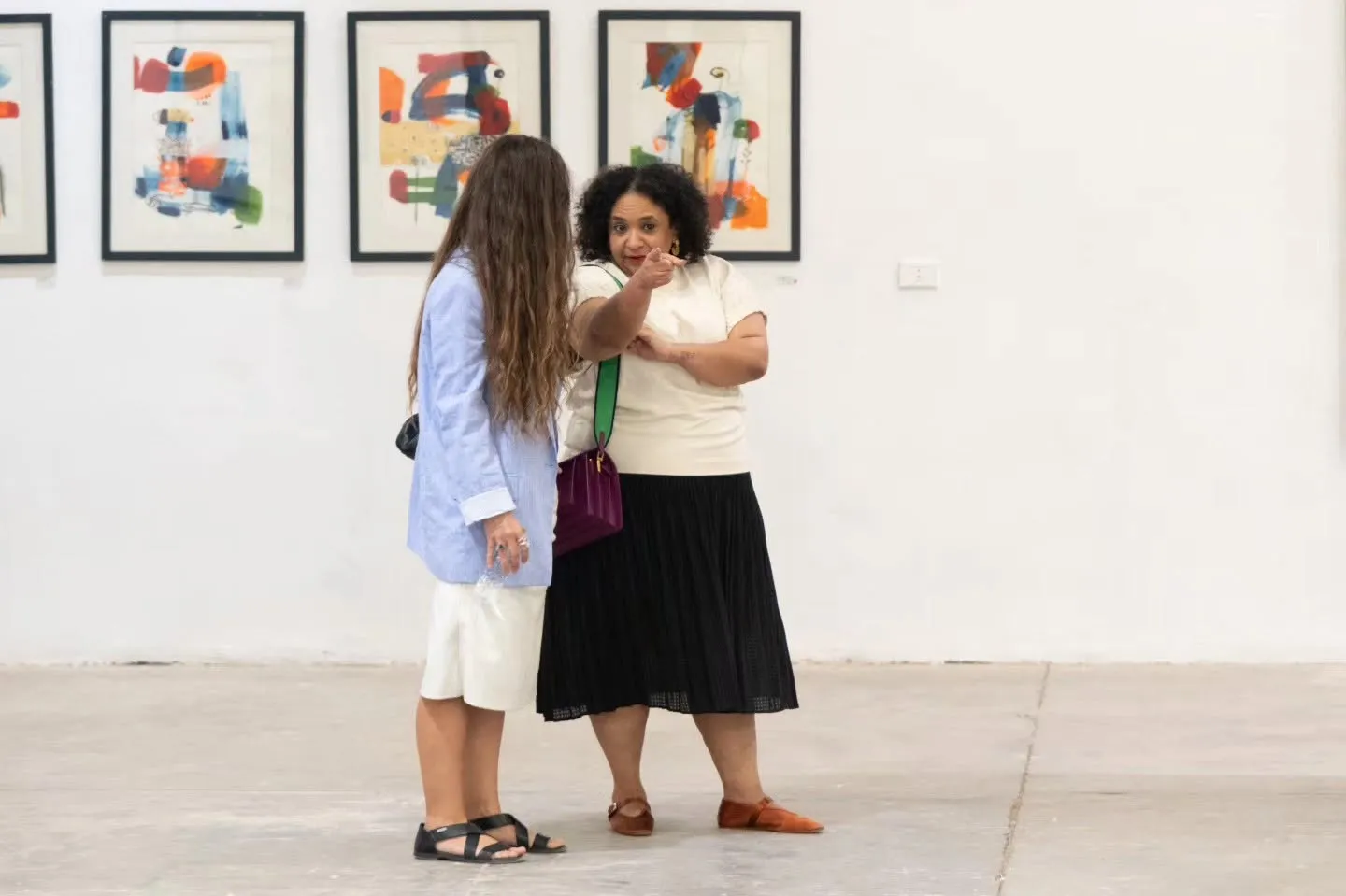
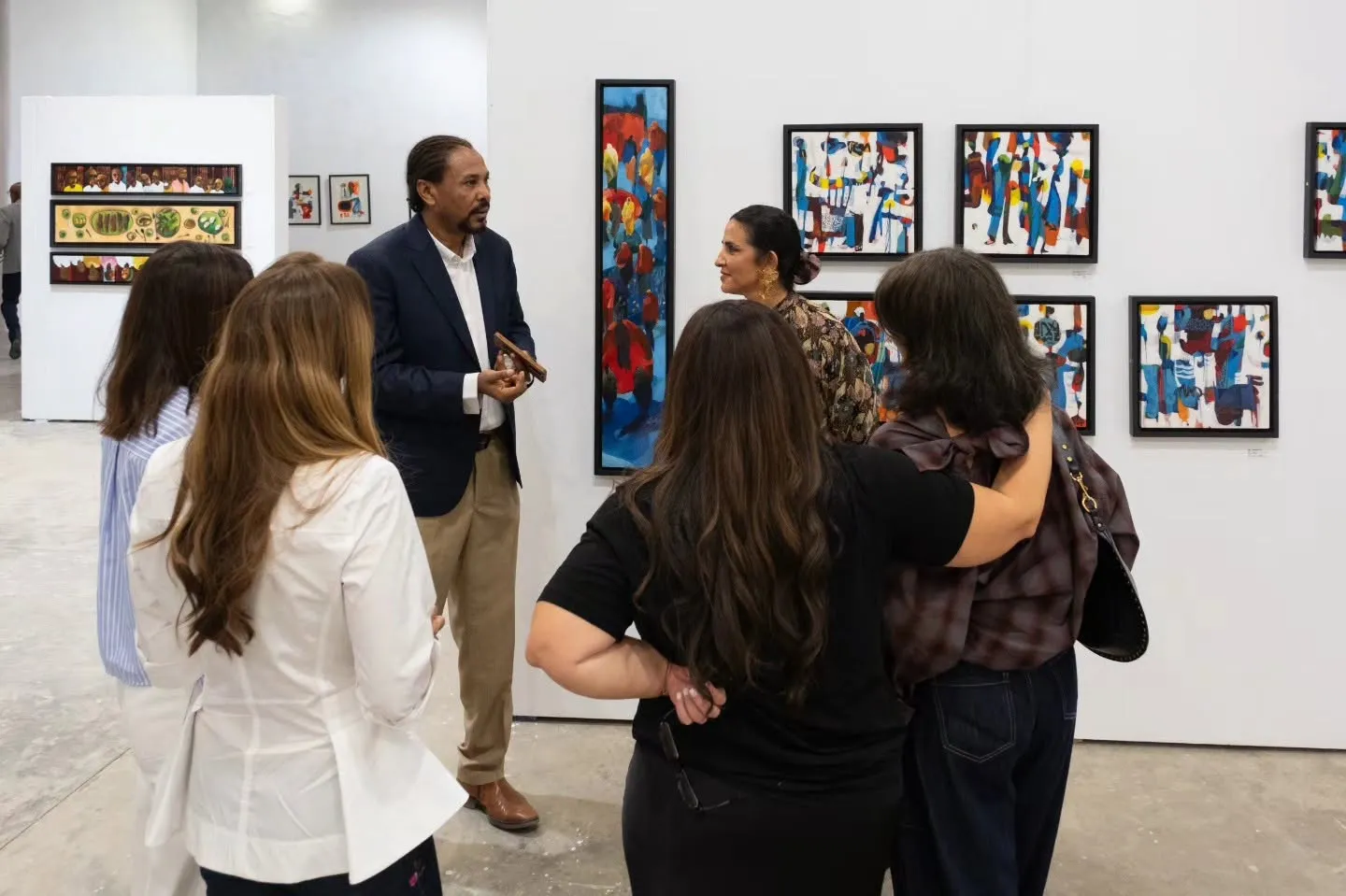
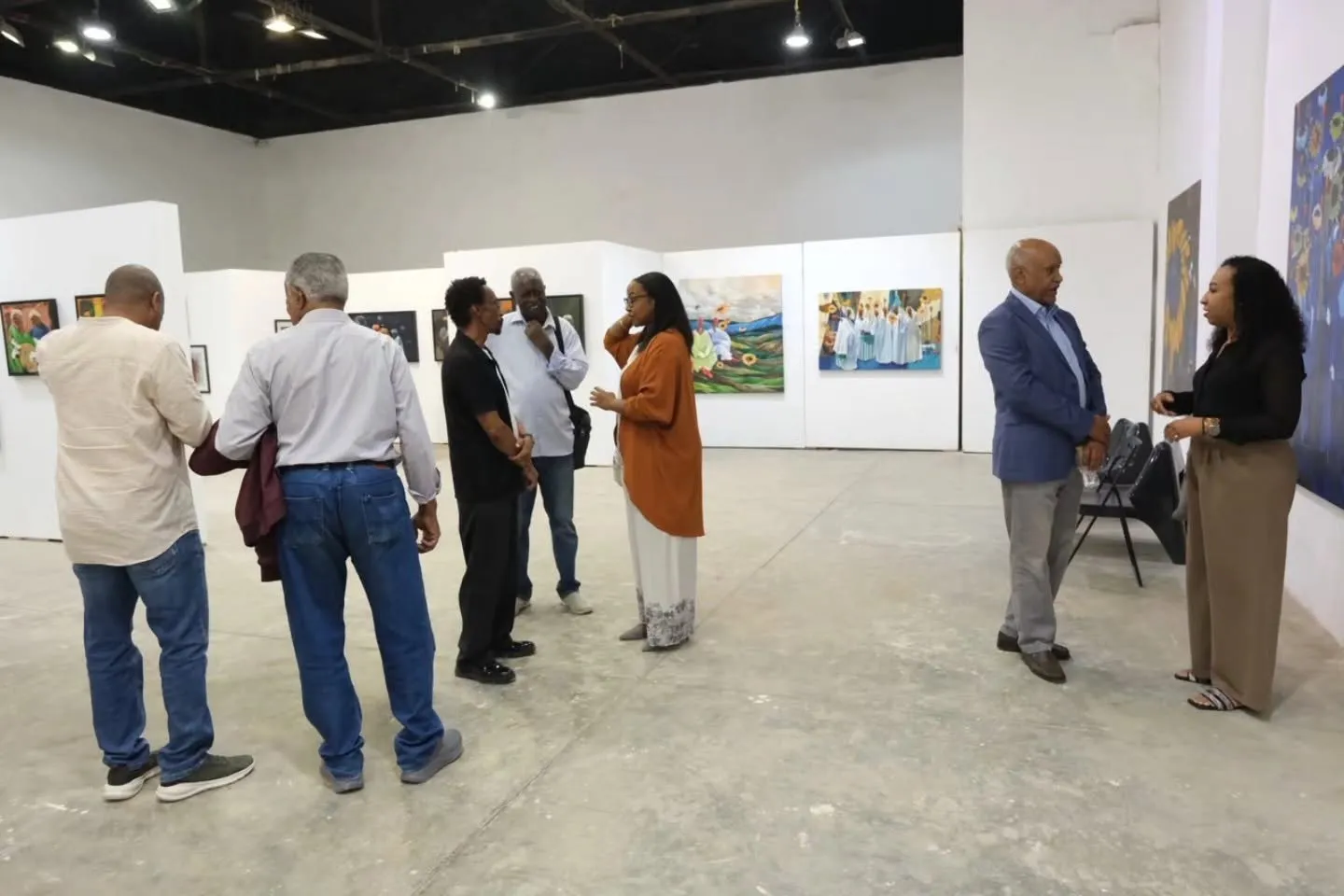
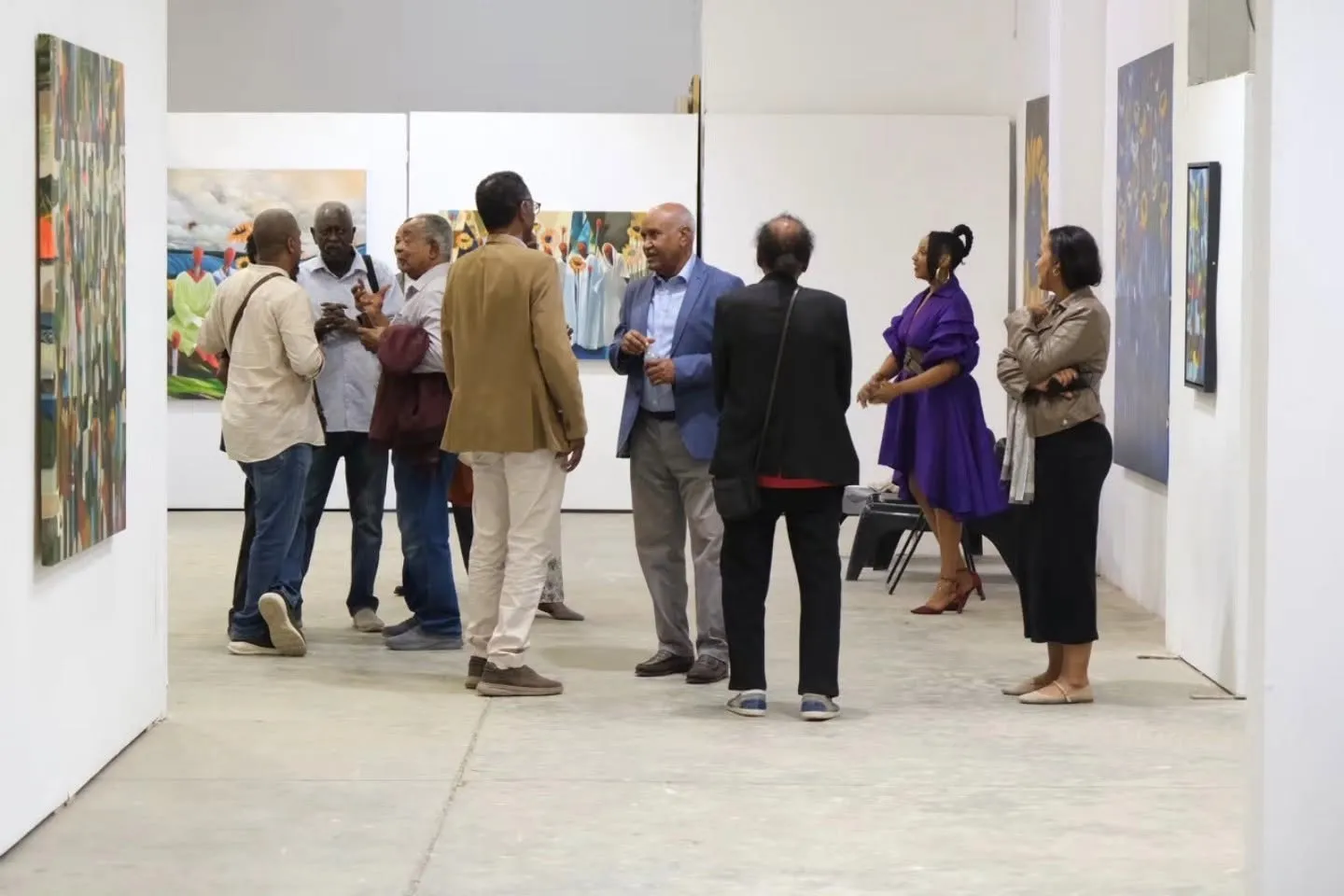
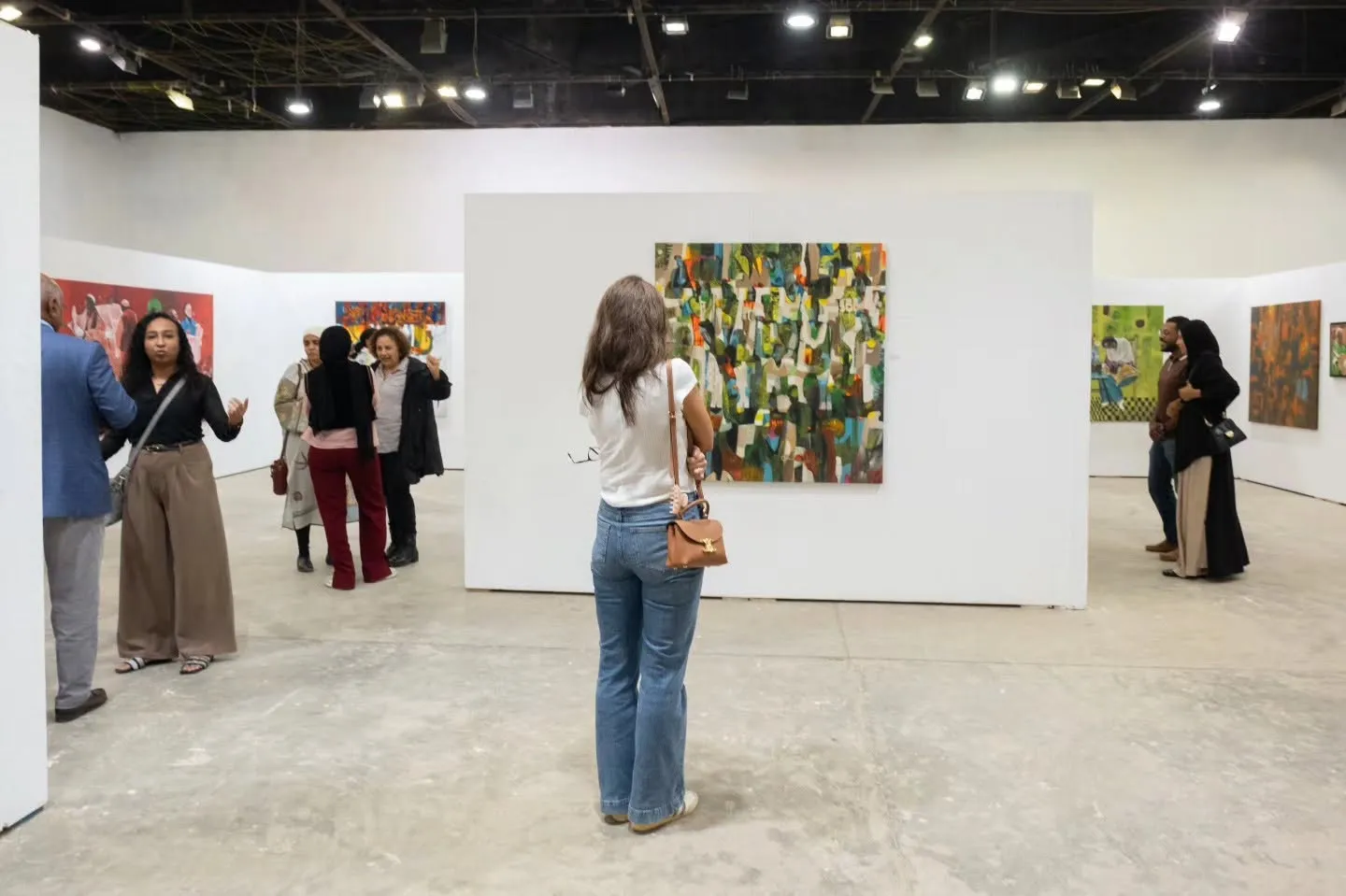
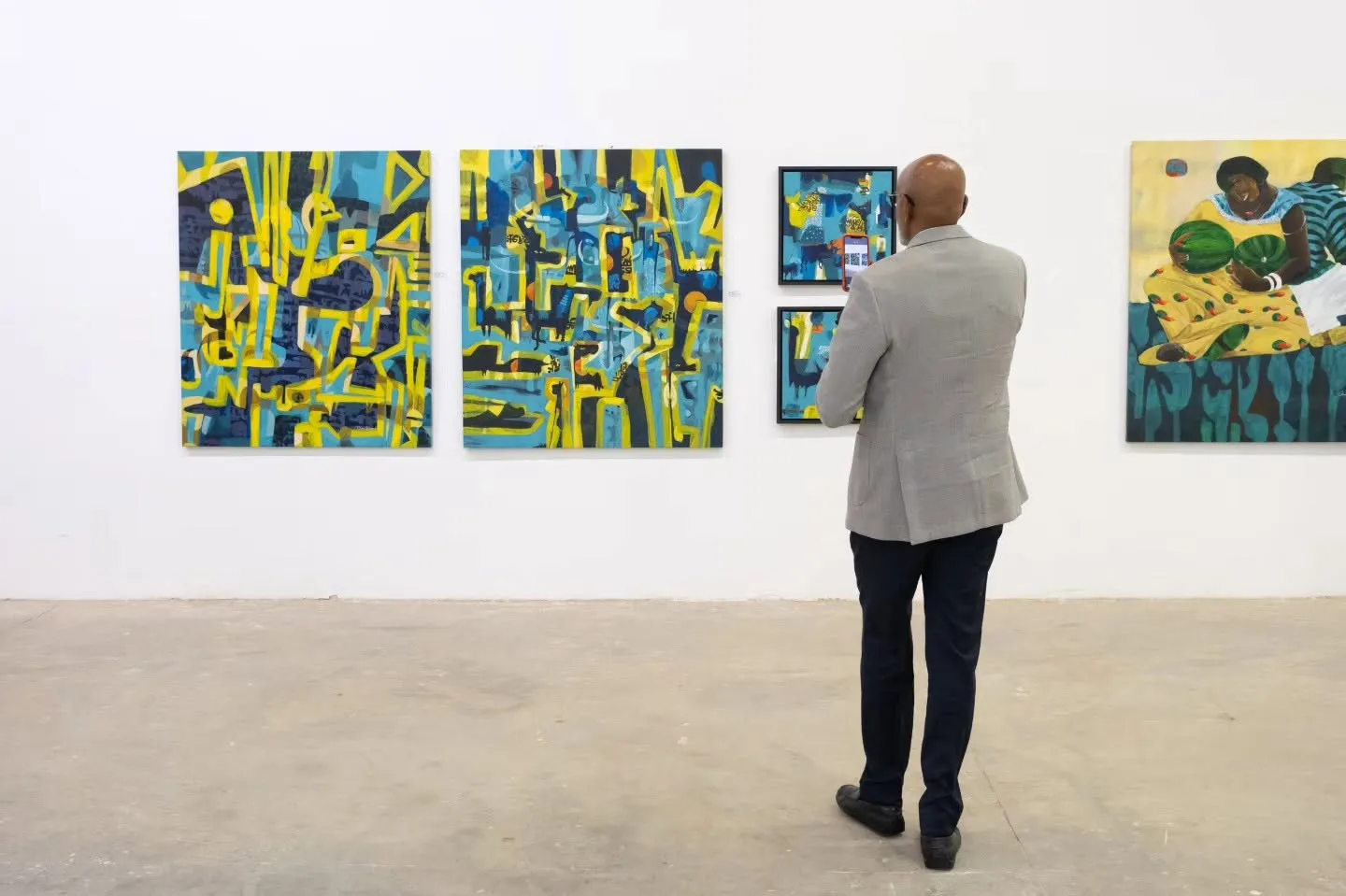
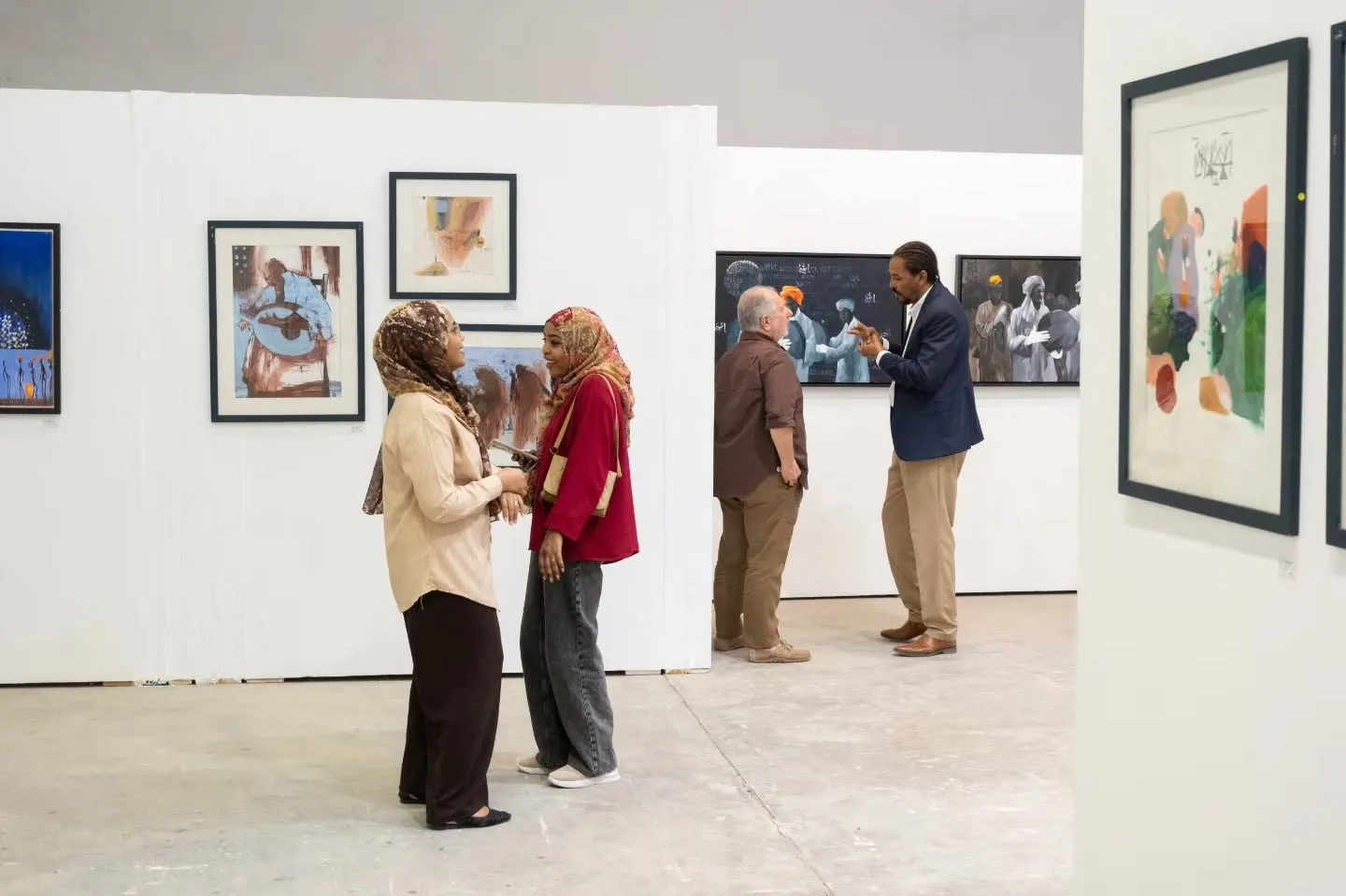
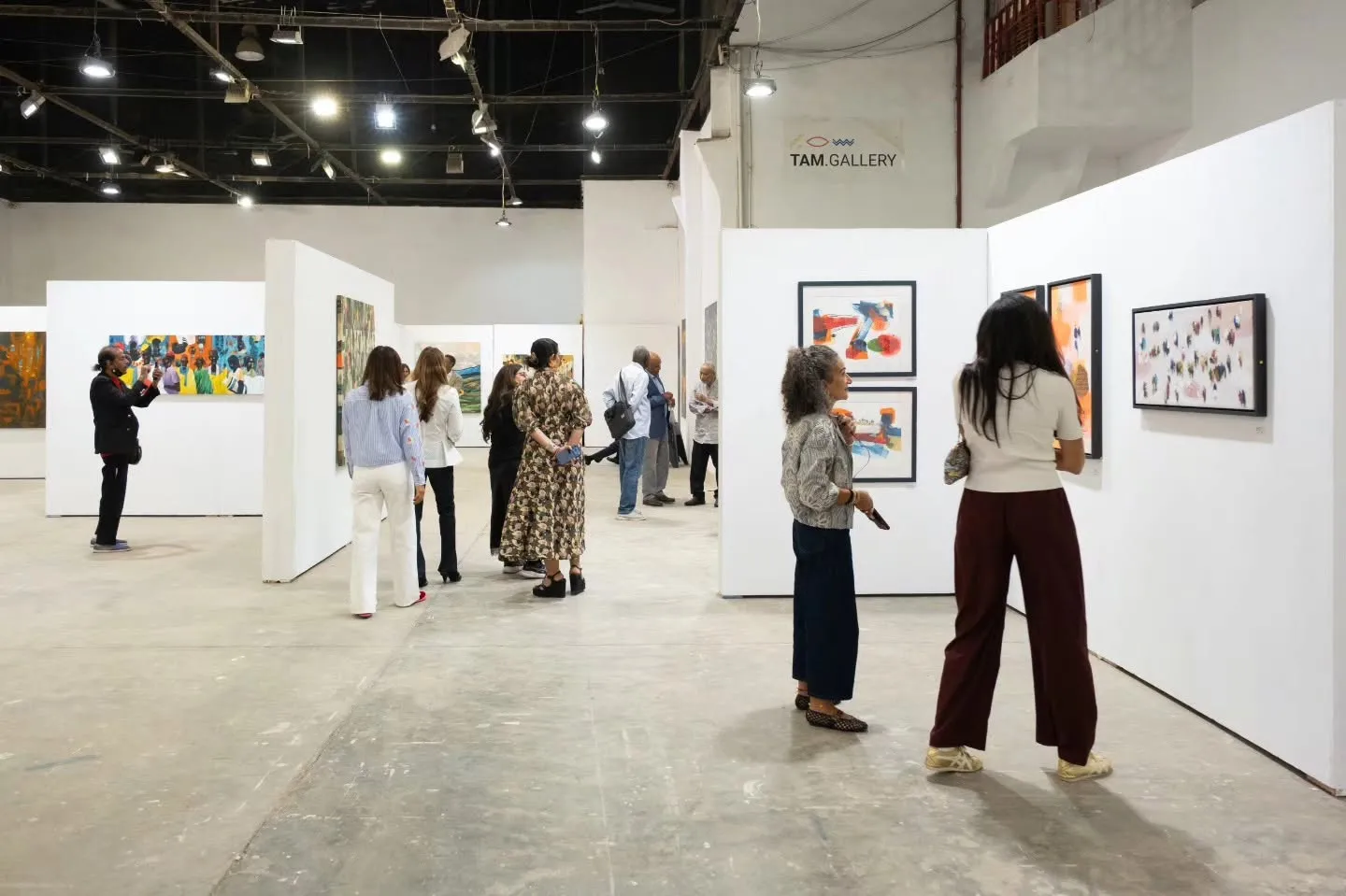
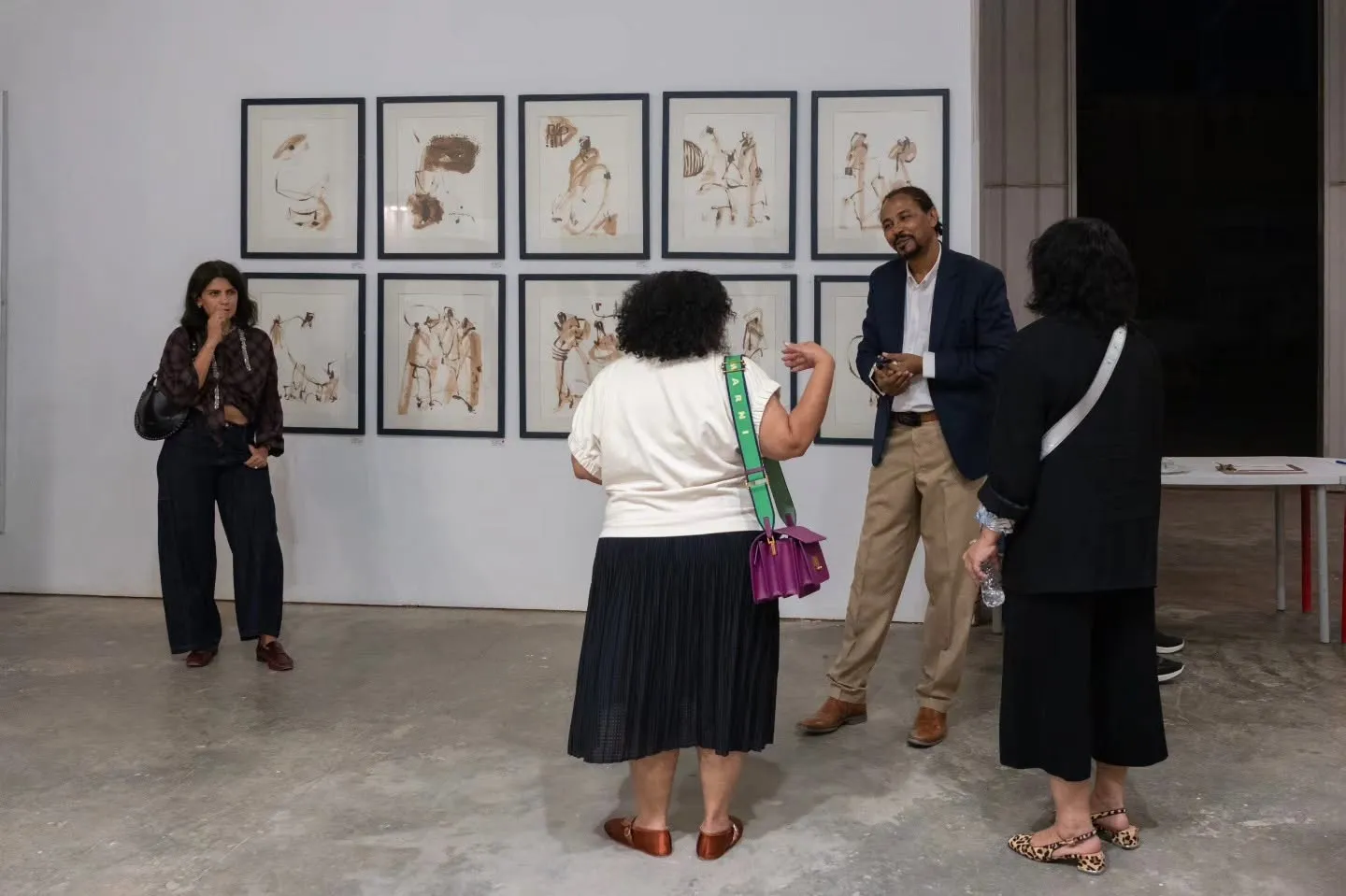
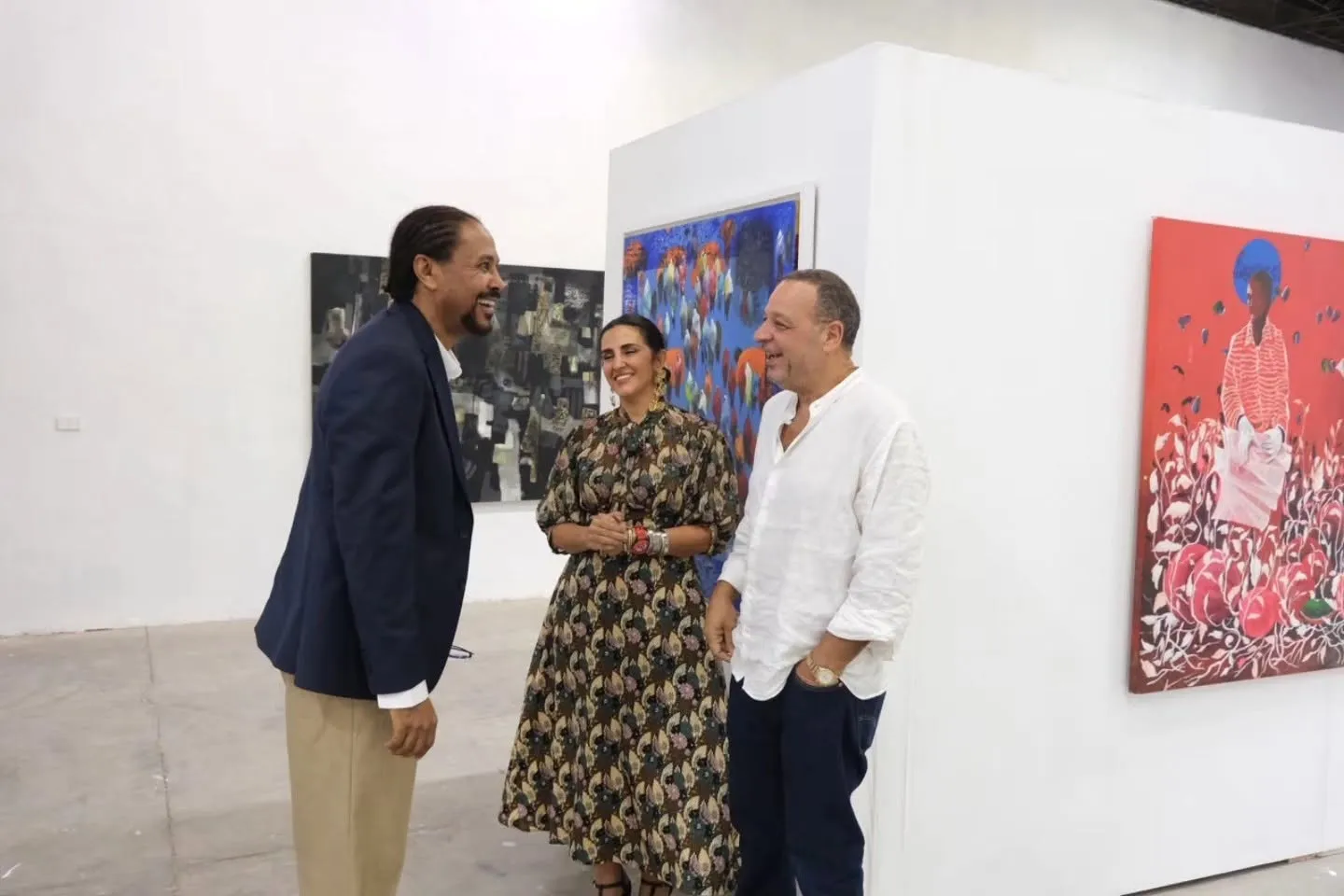
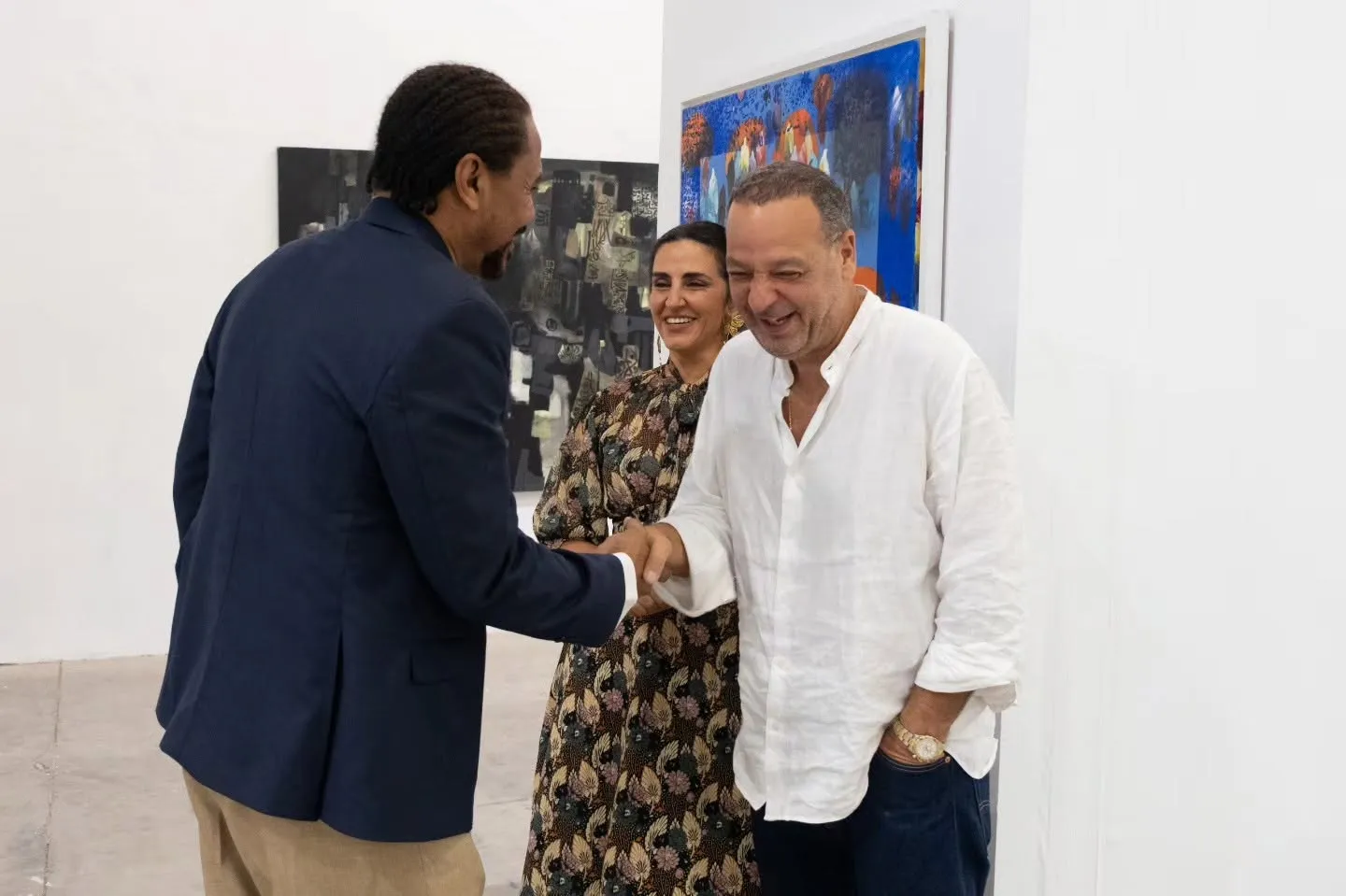
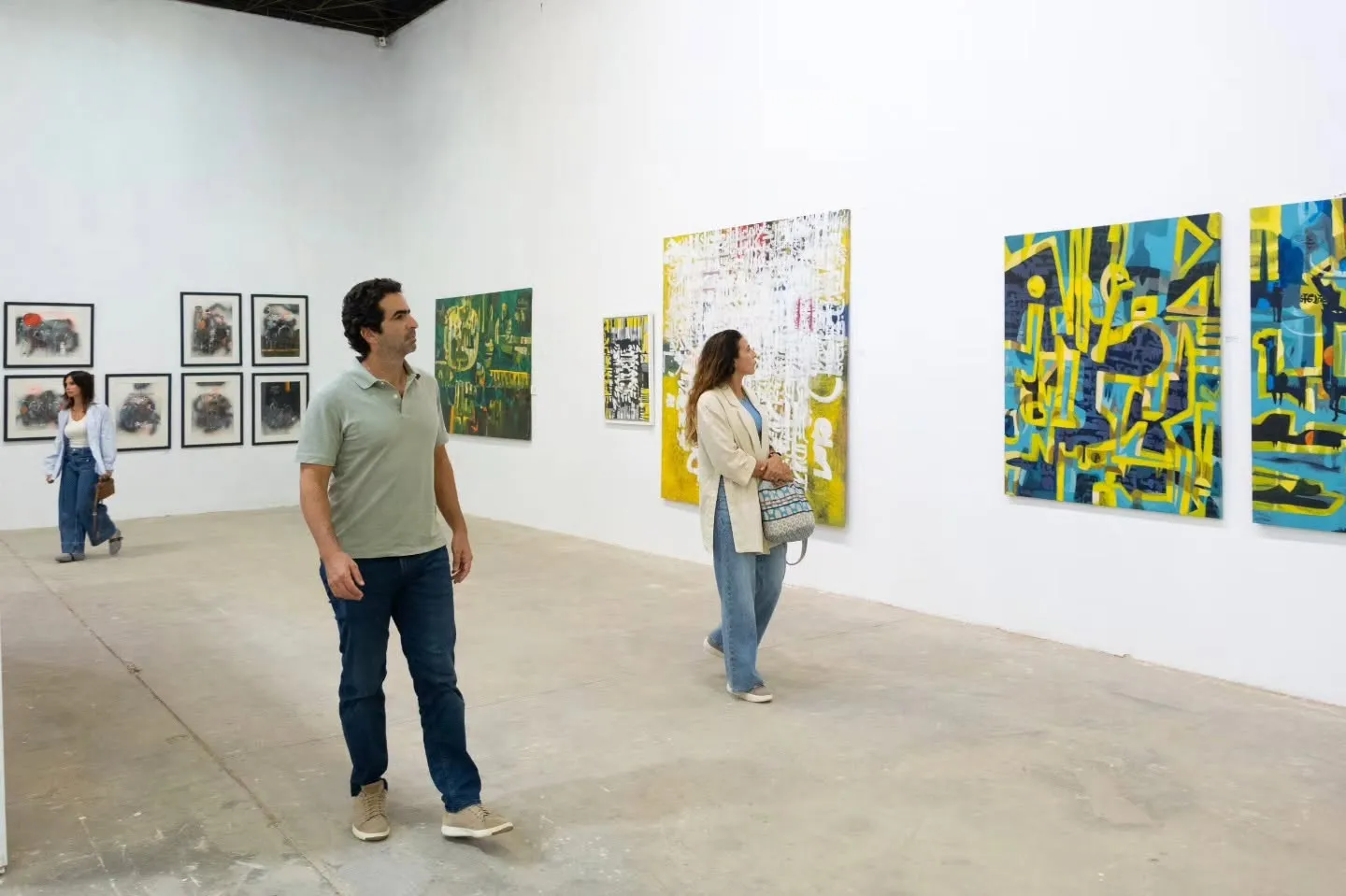
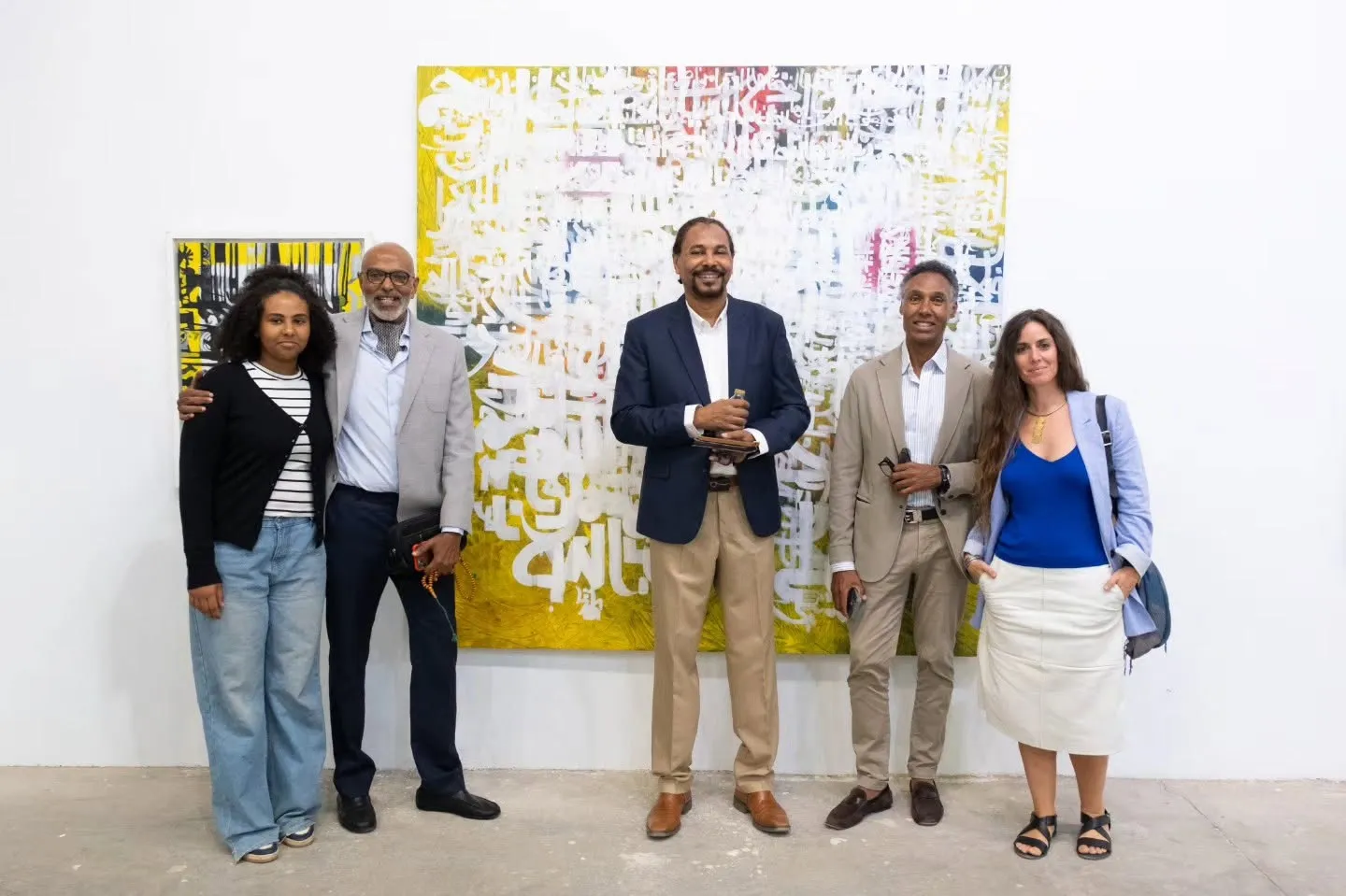
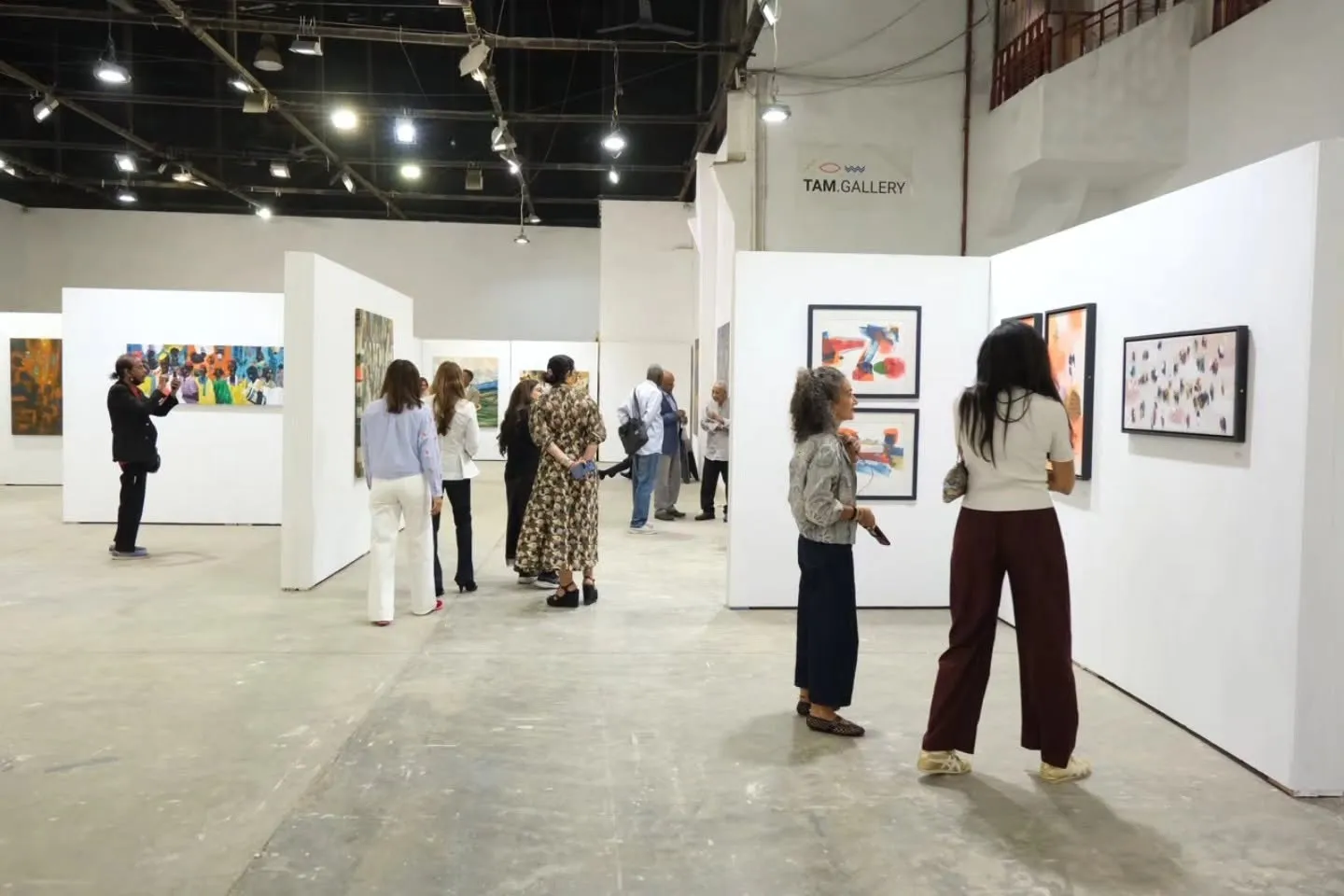
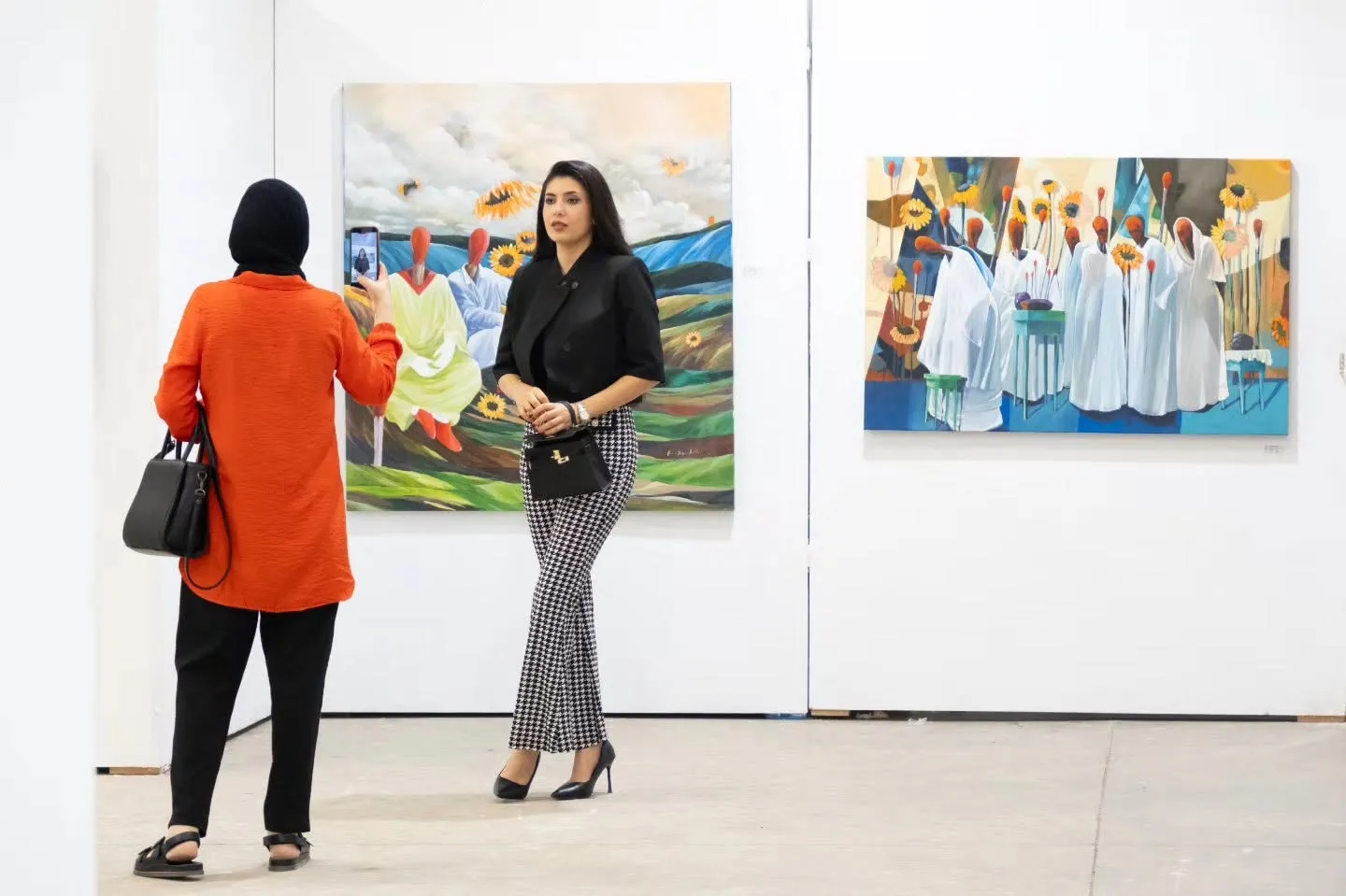
TAM Gallery is pleased to invite you to the opening of "The Tales That...", a solo exhibition by the accomplished Sudanese artist Omar Kamal. Join us for the opening reception on Saturday, October 24, from 6:00 PM to 9:00 PM, at the gallery’s premises in Abu Rawash.
With over 30 exhibitions across Africa, the Middle East, and Europe—and works held in both private and public collections worldwide—Omar Kamal brings three decades of experience and artistic mastery to this latest body of work. A recipient of the Kingdom Artists’ Forum award in Medina, Kamal approaches his practice with a vision that views art as a pure record of life, beauty, and truth.
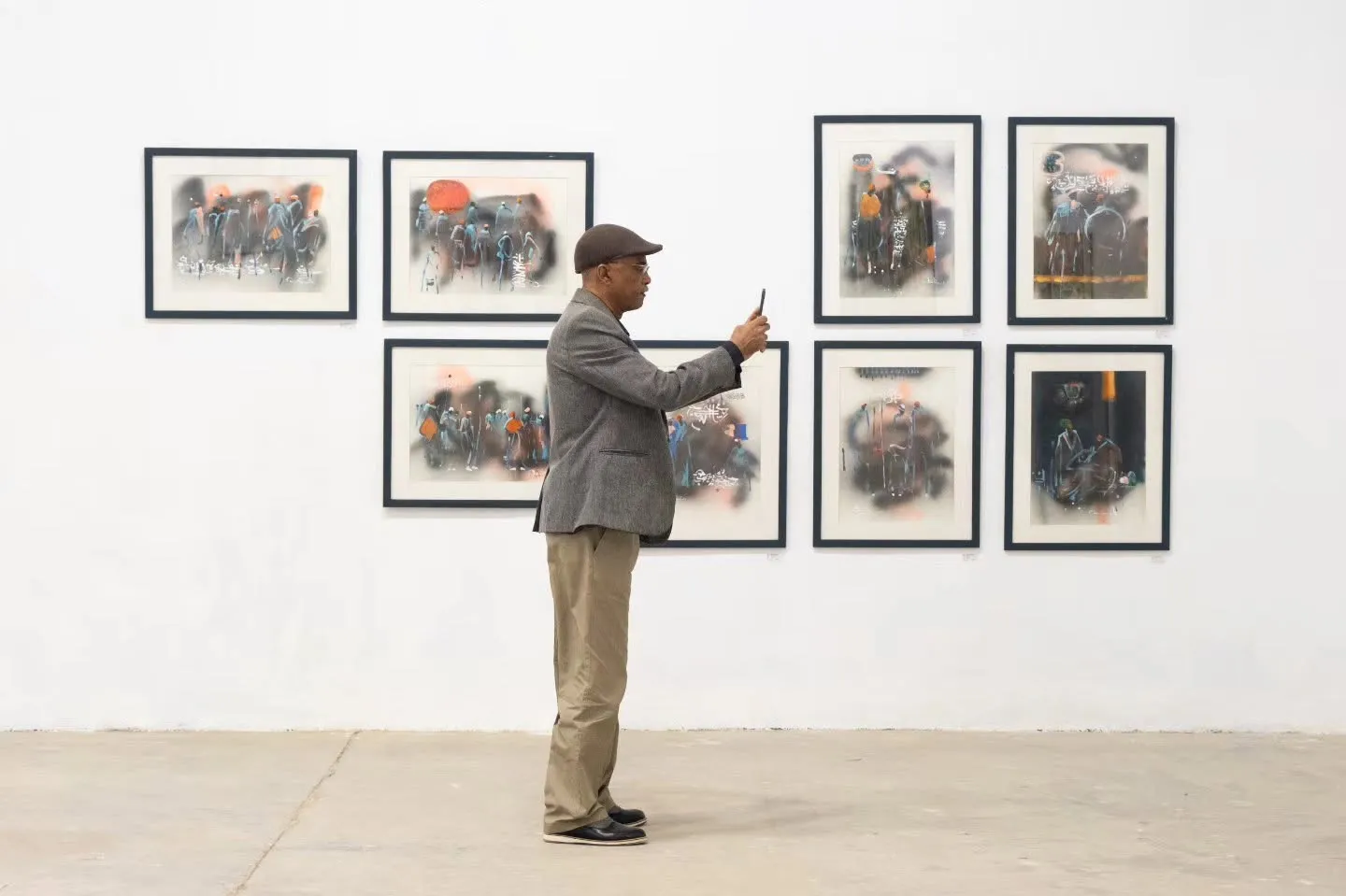
This collection navigates the fluidity of color, the rigidity of metal, and the deep darkness of charcoal, engaging directly with memory, time, and the human experience. It invites us to witness the circle as it takes shape, and to join in the unraveling of the knot.
Opening:
Saturday, October 24 | 6:00 PM – 9:00 PM
Exhibition Dates: October 24 – November 7, 2026
Location: TAM Gallery, Abu Rawash
The exhibition is open to all art enthusiasts and collectors. We look forward to welcoming you. Omar Kamal: The Protagonist of "The Tales That..."
Dr. Essam Asiri
In art, the human figure is not merely a visual form; nor is a collective necessarily a gathering of adjacent bodies or masses filling a space. In the space between the individual and their surroundings—and between personal memory and collective consciousness—the most profound questions of art take shape: How do we see ourselves in others? How do we all live? And how do the details of our daily lives transform into an image that encapsulates a history of emotions, relationships, affiliations, and events? These questions offer a gateway into the work of Sudanese visual artist Omar Kamal, and his upcoming exhibition, titled "The Tales That…," which is set to open at TAM.Gallery (The Arts-Mart Gallery) in Abu Rawash, Egypt, on October 24, 2026.
From the Sudanese Countryside to the Realm of Visual Art:
Born in 1974 in the rural village of Hillat Abbas—located in the Al-Kamlin province of central Sudan—Omar Kamal graduated from the College of Fine and Applied Arts at the Sudan University of Science and Technology, later earning a Master of Fine Arts degree, specializing in painting, in 2010. His exhibition career began as early as 1993 in the city of Omdurman, eventually expanding to include artistic engagements both within Sudan and abroad. His professional record documents participation in various Arab, African, and European countries, alongside numerous exhibitions and workshops deeply rooted in Sudan’s cultural life. (Sudan Visual Art Archive; Funoon website).
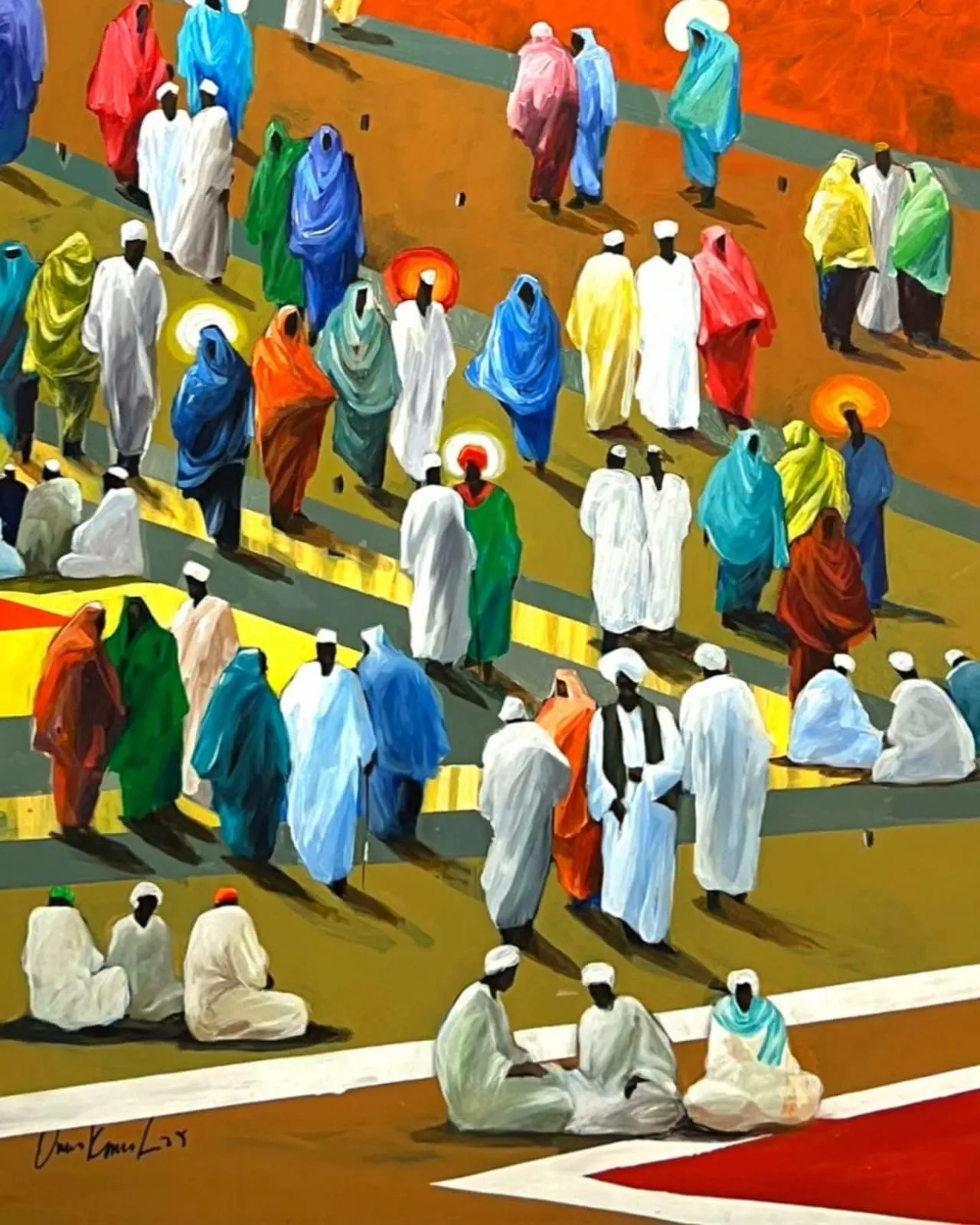
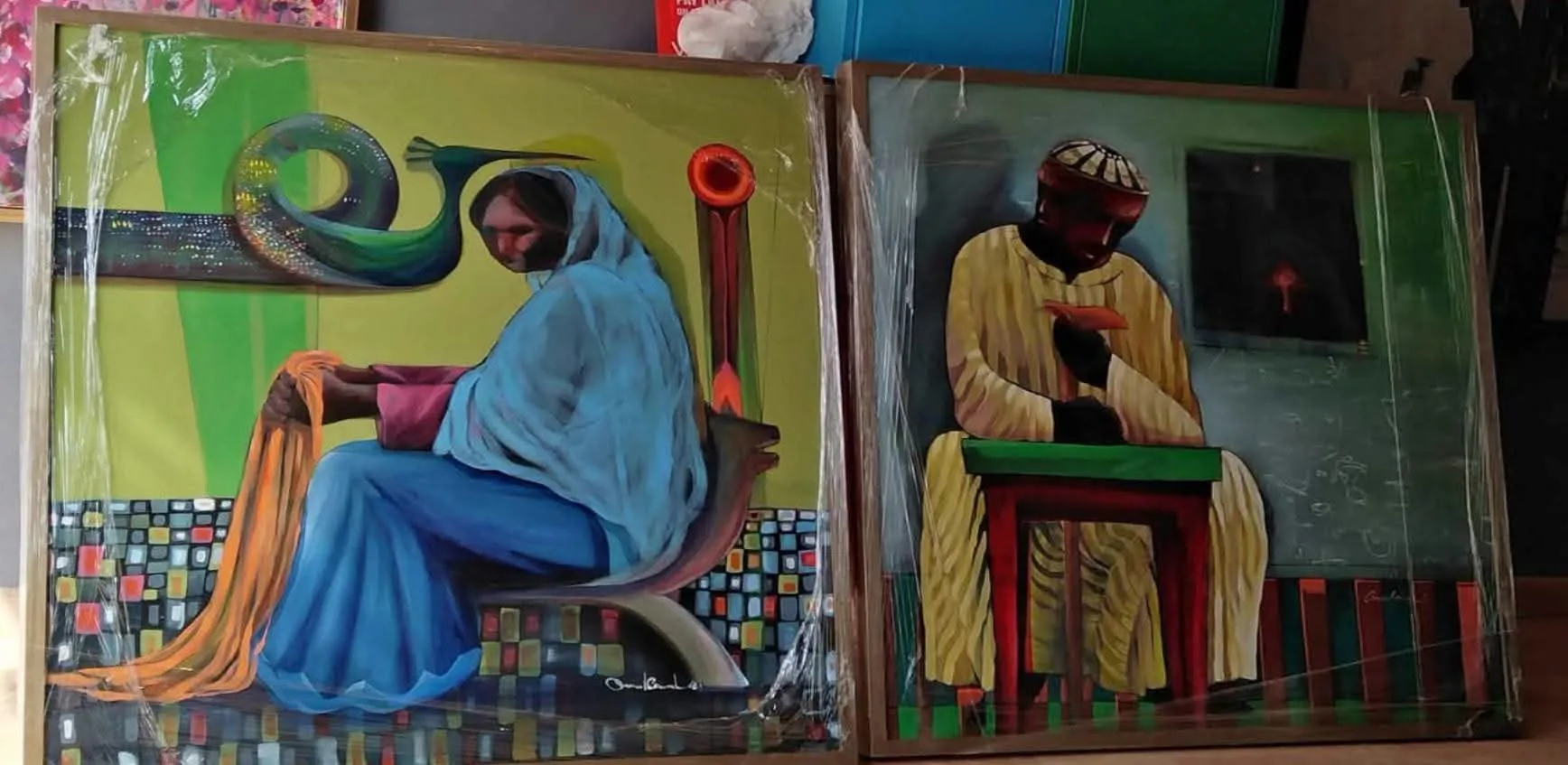
The significance of this trajectory lies not merely in the sequence of its milestones, but in the perspective it provides for understanding an artist who draws upon social life as a dynamic visual resource—one that resonates deeply with his audience. Religious celebrations, rituals, weddings, and scenes from daily life—as perceived and experienced by the artist—serve as fundamental sources for his pictorial world. Yet, drawing inspiration from life does not mean transcribing it literally onto the canvas. The true artistic endeavor begins when the artist reconstructs a scene, stripping away countless visual details to distill its essential core, thereby imbuing it with a rhythm and significance that transcend the immediate event.
Color as a Vehicle for Meaning:
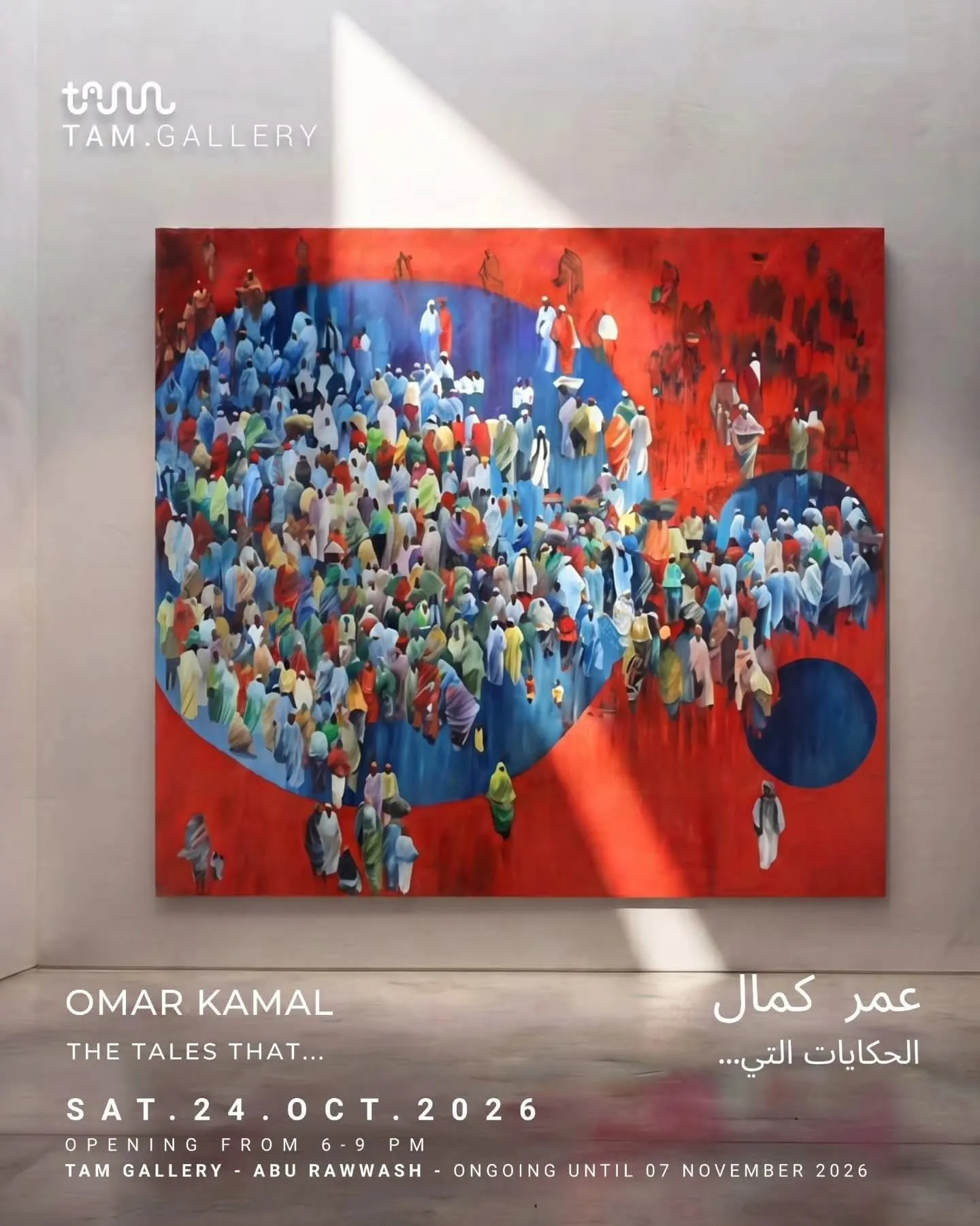
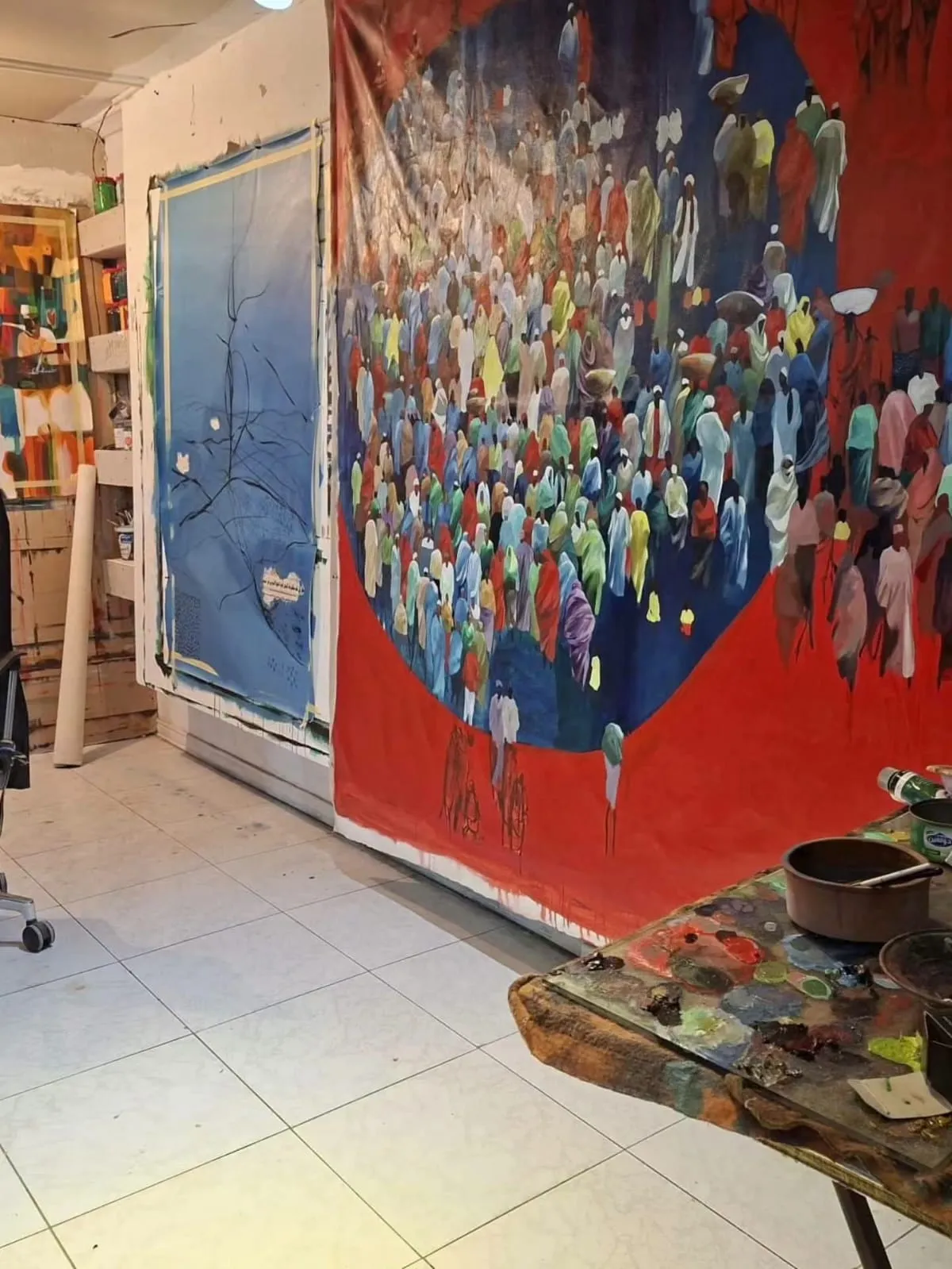
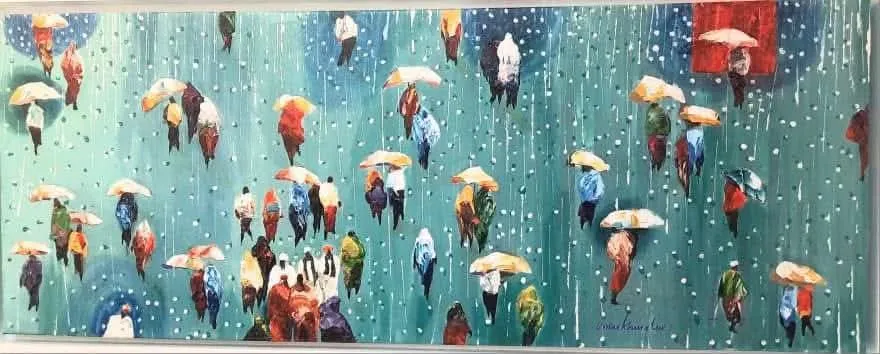
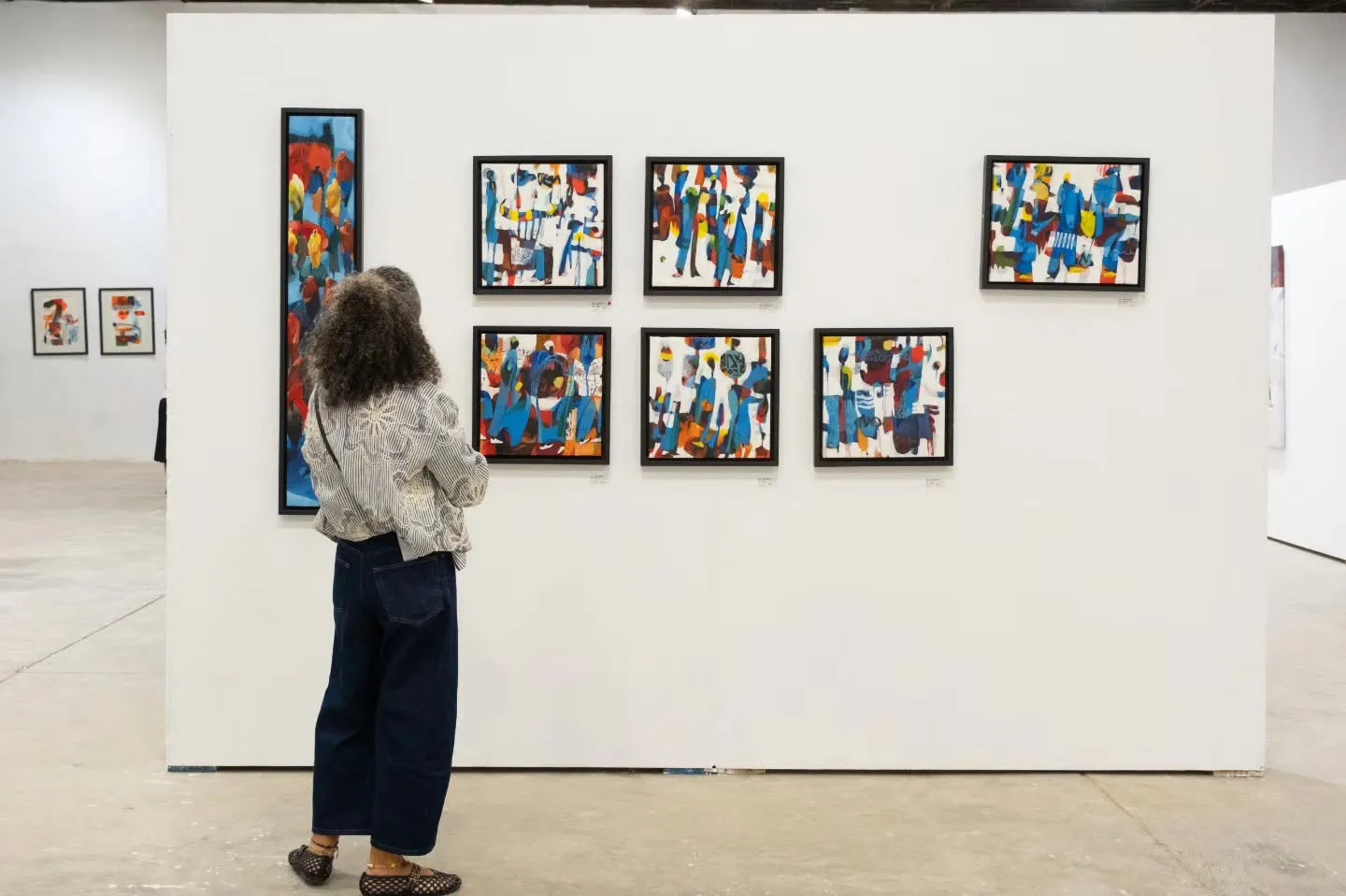
In the large-scale painting featured on the exhibition poster, we are confronted by an expansive red field, interspersed with blue areas that cradle hundreds of miniature figures. The bodies are neither arranged in rigid geometric rows nor set against a neutral background; instead, they cluster, disperse, and interweave in a continuous visual flow. At first glance, the scene appears to be a dense human throng, yet the composition invites us to contemplate how this gathering transforms into a structure defined by color and rhythm.
The color red functions as more than just a dominant hue; it establishes the space within which the figures move, imbuing the painting with a potent visual energy. The blue, meanwhile, forms organic enclosures—human "islands" nestled within a vast expanse. Between these two colors, a dynamic interplay of tension and balance emerges: the red expands the space, the blue draws the eye, and the figures lend an internal movement to these areas.
Nevertheless, the color red should not be reduced to a single meaning—such as violence or revolution—nor should blue be confined to notions of tranquility or safety. Color significance emerges from the relationships between elements within a work—through their repetition, juxtaposition, and contrast. In this specific painting, the colors derive their power from the contrast between the density of the crowds—with their diverse hues—and the vast, open spaces surrounding them.
From the Individual to the Collective:
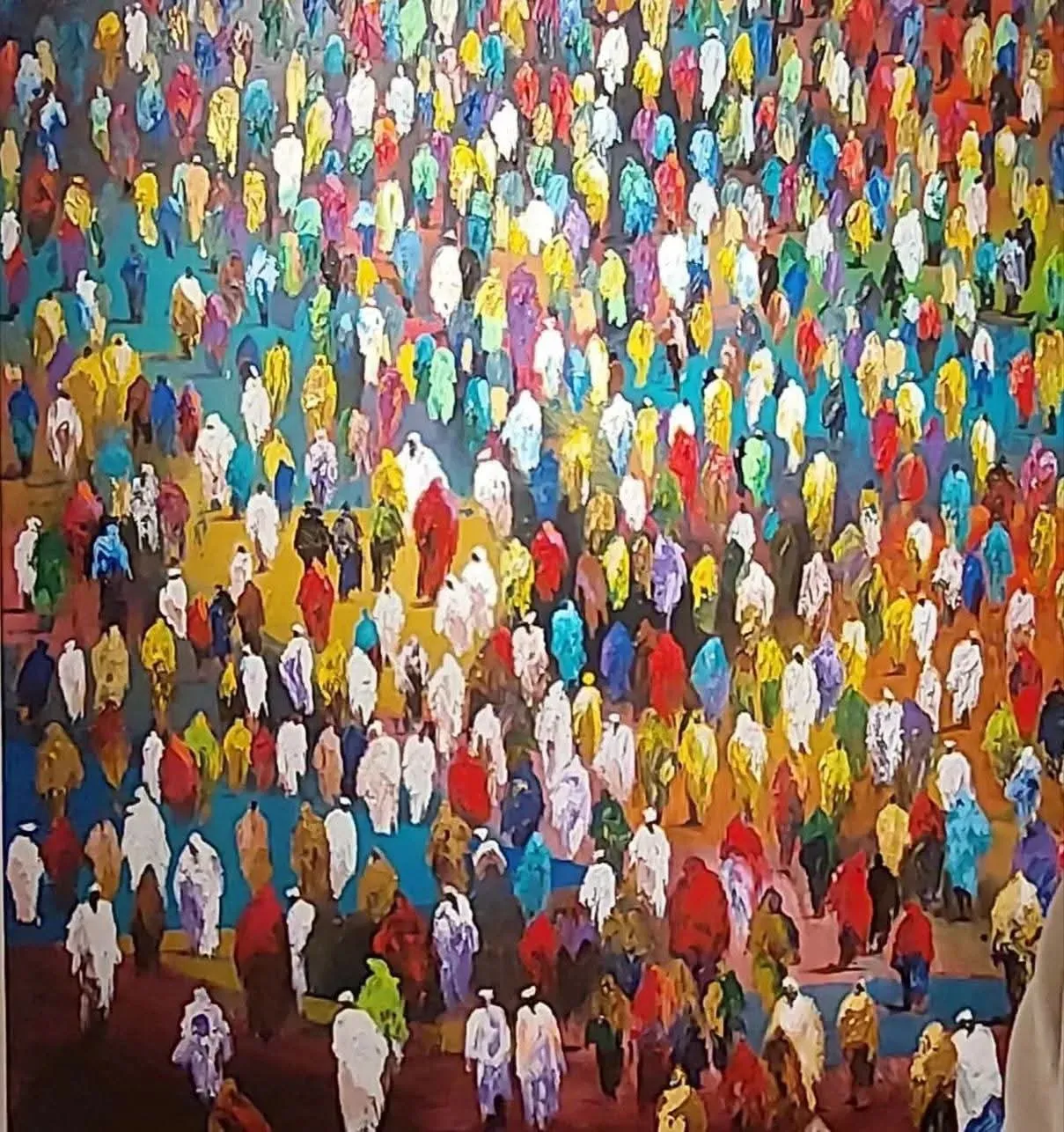
The distinct features of individual figures recede in the face of their sheer number; bodies become units—similar in scale, yet varied in color, form, and orientation. Although each figure retains a degree of autonomy, the eye cannot track every individual separately. Instead, it moves across the masses, tracing paths created by the interlocking bodies and the distribution of color.
Here, one of the expressive possibilities within Kamal’s practice comes to light: the transformation of the human figure and the crowd from a social subject into a formal, structural composition. The collective is not merely a sum of individuals, but a dynamic rhythm whose unity is forged through diversity and juxtaposition. This arrangement can be interpreted as a representation of belonging and shared experience; simultaneously, it may prompt questions regarding the individual’s place within the group—and their presence, which persists even when their visual distinctiveness fades.
This interpretation does not presuppose that the artist intended to convey a specific political or social message. In contemporary reception theory, a compelling visual work often invites multiple avenues of interpretation; its value lies in its capacity to open up lines of inquiry, rather than in providing a single, definitive answer.
Between Figuration and Abstraction:
Amidst the artist’s explorations—the tension between self and object, nature and the psyche—the figures in the painting retain their fundamental figurative traits, yet the artist does not grant absolute priority to realistic detail. Bodies are often viewed from a distance, their features distilled in favor of color, the aesthetics of movement, and the allure of mass. In this way, the work operates in an intermediate space between figurative representation and abstraction: while the human figure remains its apparent subject, the formal relationships between elements construct the visual experience.
TAM Gallery (The Arts-Mart Gallery)
https://maps.app.goo.gl/id5jyHRa93WGNHBY8